The Department of Basic Education has set the stipend for Phase III equivalent to the National Minimum Wage (NMW). According to the Department of Employment and Labour, with effect from 1 March 2022, the NMW is R23.19 for each ordinary hour worked.
Effectively, the stipend for youth appointed in Phase III of the PYEI is R4 081.44, inclusive of the employee contribution towards the Unemployment Insurance Fund (UIF).
Thus, the monthly stipend payable to the assistants is R4 040,63, after the deduction of one percent (1%) employee contribution towards UIF, which is R40,81.
The following provisions are made in the contract of employment for Phase III:
- An employer shall not deduct money from the EA/GSA’s payment without the EA/GSA’s consent unless the deduction is required in terms of the law.
- An employer must deduct and pay to the Department of Employment and Labour, the Unemployment Insurance Fund (UIF) that the EA/GSA is required to pay.
- An employer may deduct any money that was overpaid to the EA/GSA erroneously.
- An employer may not require or allow the EA/GSA to pay the employer or any person for having been employed.
- An employer may deduct from the stipend of the EA/GSA the amount equal to the number of days that the Assistant took leave that is outside the allocated leave days.
The youths are entitled to one-day vacation leave for every full month that the EA/GSA has worked in terms of the contract. Where an individual has taken leave more than the days they are entitled to, there will be a pro-rata deduction for the month in which the excess leave days were taken.
The schools are not allowed to make any arbitrary deductions, which are not in line with the contract of employment signed between the youths and the school.
Training and upskilling of youth placed in PhaseiIii of the Presidential Youth Employment initiative (PYEI)
The Presidential Youth Employment Initiative (PYEI) implemented in the Basic Education Sector seeks to provide youth with learning and earning opportunities. It is geared towards supporting livelihood and serves as a vehicle to address high levels of youth unemployment in South Africa.
One of the key objectives of the PYEI in the Basic Education Sector is to provide the beneficiaries with skills and competencies that will enhance their prospects for future employment.
To this end, the Department of Basic Education has leveraged on some of the training offerings by its partners to skill the youth appointed in schools.
The training partners include Digify Africa, offering online safety training; NEMISA, offering digital literacy training; 2Enable, offering an on-line e-Learning training course; and Pinnock Consulting, hosting the National School Safety Framework (NSSF) training.
There are additional training and learning material hosted by eCubed on the TeacherConnectlearn portal, which is a zero-rated website.
These include curriculum training for curriculum assistants, compulsory generic orientation, and the Reading Champions Training.
The table below summarises the training offerings that can be accessed online, all of which are self-paced and mediated:
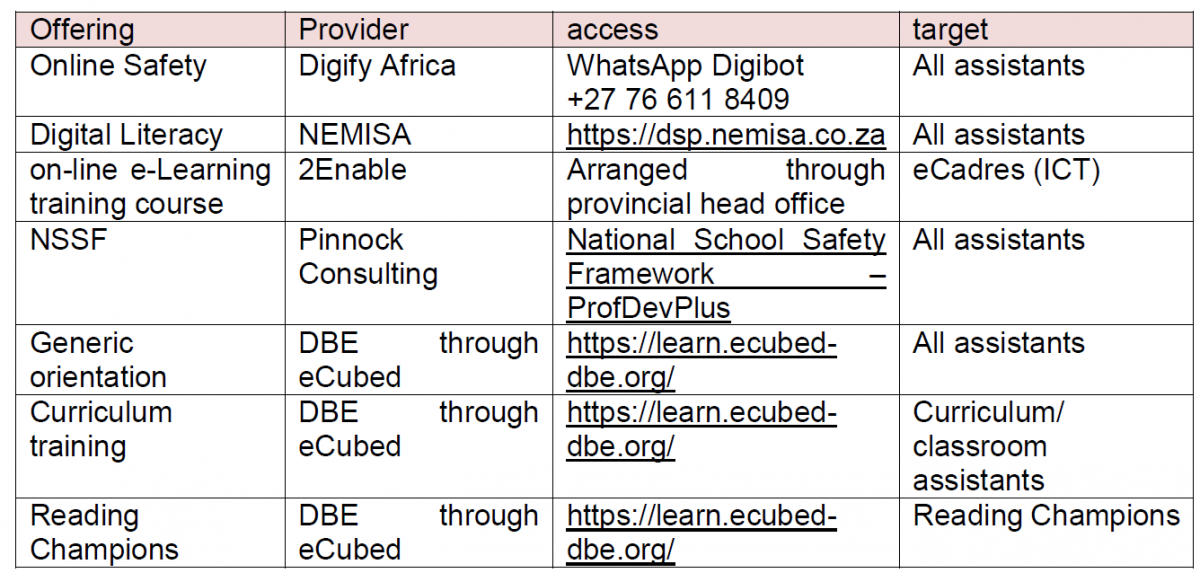
All the participants are required to complete the various available training to enhance their skills and to empower themselves.
Should additional information on how to access the training be required, an email inquiry should be sent to beei@dbe.gov.za.
The DBE wants to ensure that all the youths appointed in school under the banner of the PYEI gain meaningful experiences to useful learning opportunities
Need Information or Confused about Something ?
Ask a QuestionStudent Loans in South Africa: How to Apply and What to Expect
For many young South Africans, accessing higher education is a dream that often comes with a financial challenge. Fortunately, several student loan optionsstrong> are available in South Africa to help fund university, college, or TVET studies. Whether you’re looking for a government loan like NSFAS or a private student loan from a bank, understanding the process is essential for success.
What Are Student Loans?
Student loans are a form of financial aid provided to eligible students to help cover tuition fees, books, accommodation, and other study-related expenses. In South Africa, these loans can come from government institutions like NSFAS or private banks such as Nedbank, Standard Bank, FNB, and Absa. Most loans offer repayment flexibility and low-interest options until you graduate.
Types of Student Loans in South Africa
- NSFAS (National Student Financial Aid Scheme): A government-funded loan/grant program for students from low-income households. Covers tuition, housing, transport, and meals.
- Bank Student Loans: Offered by most major banks. These are credit-based and require a guardian or parent as a co-signer.
- Private Loan Providers: Companies like Fundi offer educational loans covering various costs such as school fees, gadgets, and textbooks.
Requirements to Qualify for a Student Loan
Each provider has its own criteria, but most South African student loans require the following:
- Proof of South African citizenship or permanent residency
- Proof of registration or acceptance at a recognised tertiary institution
- Parent or guardian with a stable income to co-sign (for private loans)
- Completed application form with supporting documents (ID, proof of income, academic records)
How to Apply for a Student Loan
To apply for a student loan in South Africa, follow these steps:
- Identify your loan provider: Choose between NSFAS, a bank, or a private lender.
- Gather necessary documents: ID copies, academic transcripts, acceptance letters, and income statements.
- Complete the application form online or at a branch.
- Await approval: Some banks offer instant decisions, while NSFAS can take a few weeks.
- Receive disbursement: Funds are typically paid directly to the institution or your account, depending on the lender.
Loan Amounts and Repayment
The loan amount you can receive depends on your chosen lender and financial need:
- NSFAS: Covers full tuition, residence, books, and a personal allowance. The loan becomes a bursary if you pass all your courses.
- Banks: Can provide up to R120,000 or more annually, depending on tuition costs and credit history.
Repayment usually starts after graduation or once you start earning an income. Bank loans may require interest-only payments during your studies. NSFAS repayment only begins when you earn above a specific income threshold.
FAQs on Student Loans in South Africa
1. Can I apply for a student loan without a parent or guardian?
For government loans like NSFAS, yes. But most banks require a financially responsible co-signer, especially for students without an income.
2. Is NSFAS a loan or a bursary?
NSFAS starts as a loan, but it converts to a bursary if you meet academic performance requirements. This means you may not have to pay it back.
3. What is the interest rate on student loans?
Private banks offer competitive rates between 5% and 12%, depending on the applicant's credit profile. NSFAS charges a much lower interest rate, usually linked to inflation.
4. What happens if I fail my courses?
If you’re funded by NSFAS and fail, your loan won’t convert into a bursary, and you’ll need to repay the full amount. Banks may continue charging interest, and your co-signer may be held liable.
5. Can I use a student loan to pay for accommodation and laptops?
Yes. Both NSFAS and many bank student loans cover costs beyond tuition, including housing, meals, textbooks, and electronic devices like laptops or tablets.
Final Thoughts
Student loans in South Africa offer a much-needed financial lifeline to thousands of students every year. Whether you're applying through **NSFAS** or a private bank, ensure you understand the **terms, interest rates, and repayment conditions** before signing any agreement. Make informed decisions today to secure your academic and financial future tomorrow.